
 Cosmetics
 Grooming equipment
 Grooming tools
 Health and wellbeing
 Accessories


 2026-02-26
Tools for Animal Coat Care
Why is the greatest damage most often done here?
When talking about coat care, we most often emphasize:
- shampoos
- conditioners
- masks
- sprays
- frequency of procedures
However, we very often forget one essential thing – tools.
And this is exactly where the greatest, long-term, difficult-to-repair damage is often done.
Even the best cosmetics cannot protect the coat if it is mechanically damaged every day by an unsuitable brush or comb.
Mechanical damage – the silent enemy of the coat
Hair is a protein structure (keratin), covered by a protective layer – the cuticle. It is like small scales that:
- protect the inner hair structure,
- maintain moisture,
- provide elasticity,
- are responsible for shine.
When an unsuitable tool is used:
- the scales are lifted,
- the hair becomes rough,
- micro-cracks appear,
- ends begin to break,
- roots weaken due to constant pulling.
Most often this damage is not visible immediately.
It accumulates gradually.
And only after several months do we notice that:
- the coat no longer grows as before,
- it begins to mat “without reason,”
- it becomes dry even when using good cosmetics,
- it loses elasticity,
- it easily attracts dirt and debris,
- it looks “tired.”
Very often this is attributed to genetics or “this type of coat.”
In reality, it is often the result of mechanical damage.
Why is tool selection not universal?
One of the biggest myths is that there is “one good brush for everyone.”
That is not true.
Tools must be selected according to:
- coat type
- hair structure
- coat density
- presence of undercoat
- whether the coat is straight, curly, silky
- whether the animal is shedding
- whether the coat tends to mat
This applies to all without exception:
- long-coated
- short-coated
- curly
- double-coated
- silky
- wire-coated
Even a short-coated dog can be damaged by the wrong tool.
Main tools and their purpose
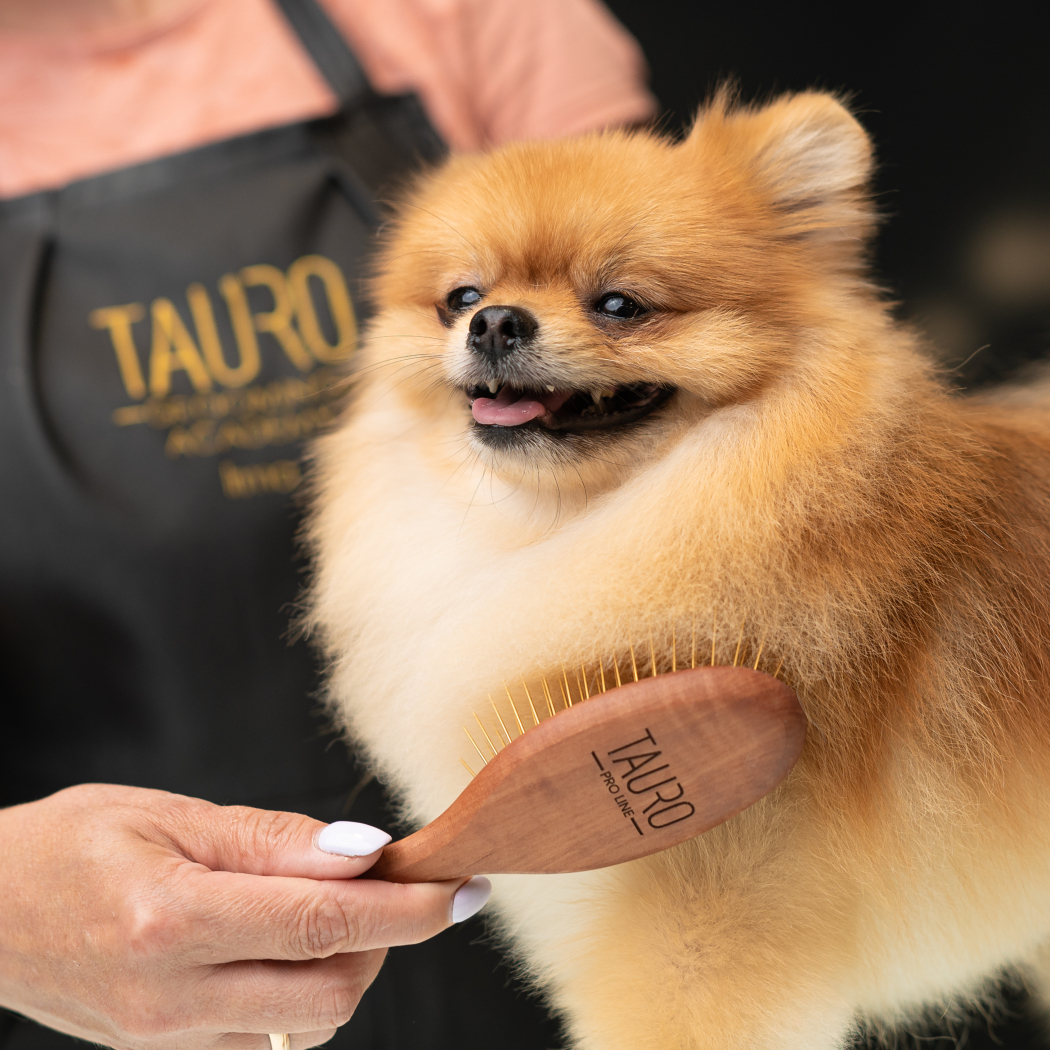
1. Pin brushes (metal pins)
Suitable for:
- long coats
- silky coats
- gentle brushing after bathing
Important:
- pins must be smooth, without sharp edges
- tips must not be too rough
- the base must be flexible to absorb pressure
An unsuitable pin brush:
- tears the hair
- pulls from the roots
- causes discomfort
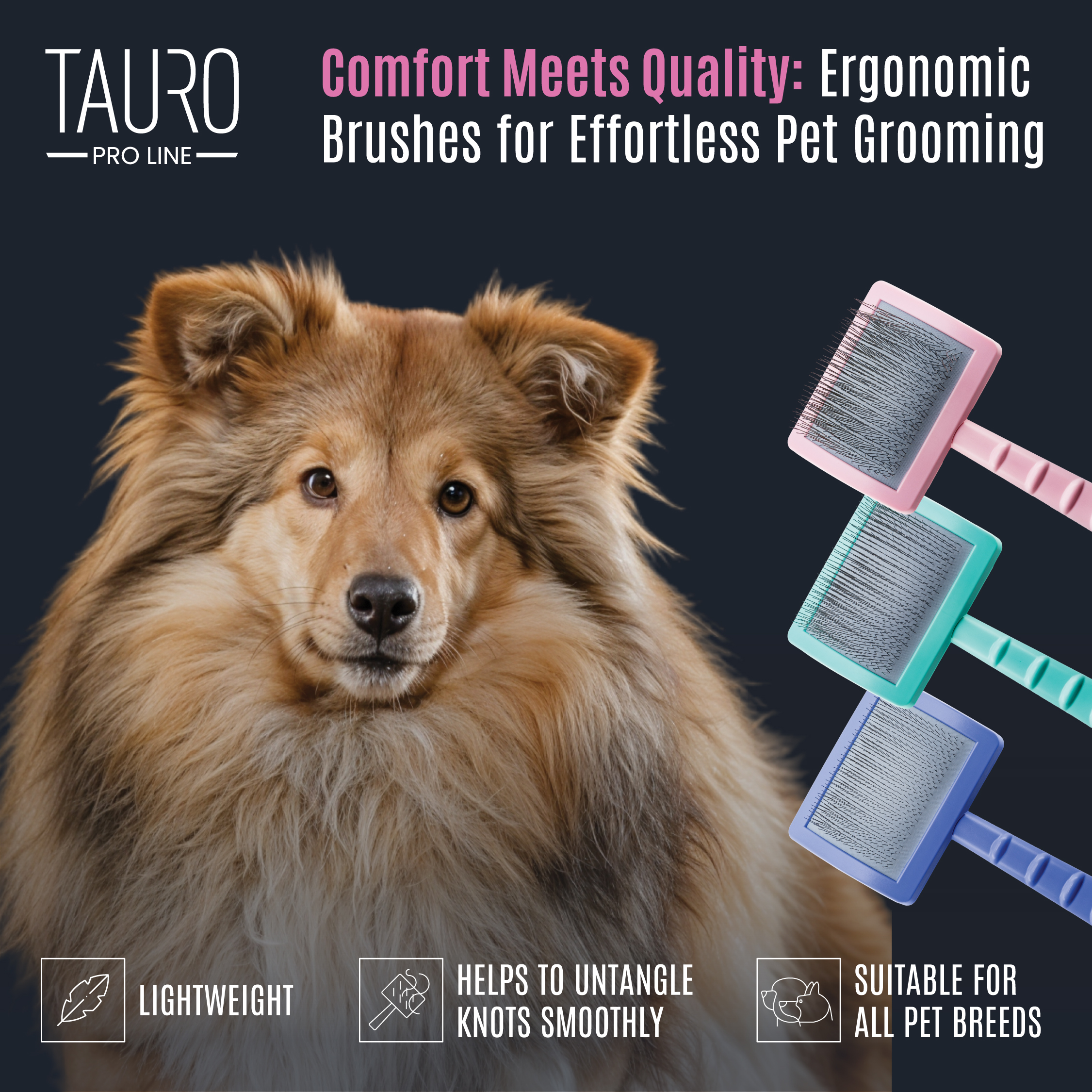
2. Slicker brushes
Designed for:
- removing mats
- dense coats
- curly coats
However:
- this is a more aggressive tool
- when used incorrectly it can tear the coat
Most important:
- do not use in a “scrubbing” manner
- work in layers
- use only when truly needed
A slicker is not a daily gentle brush.
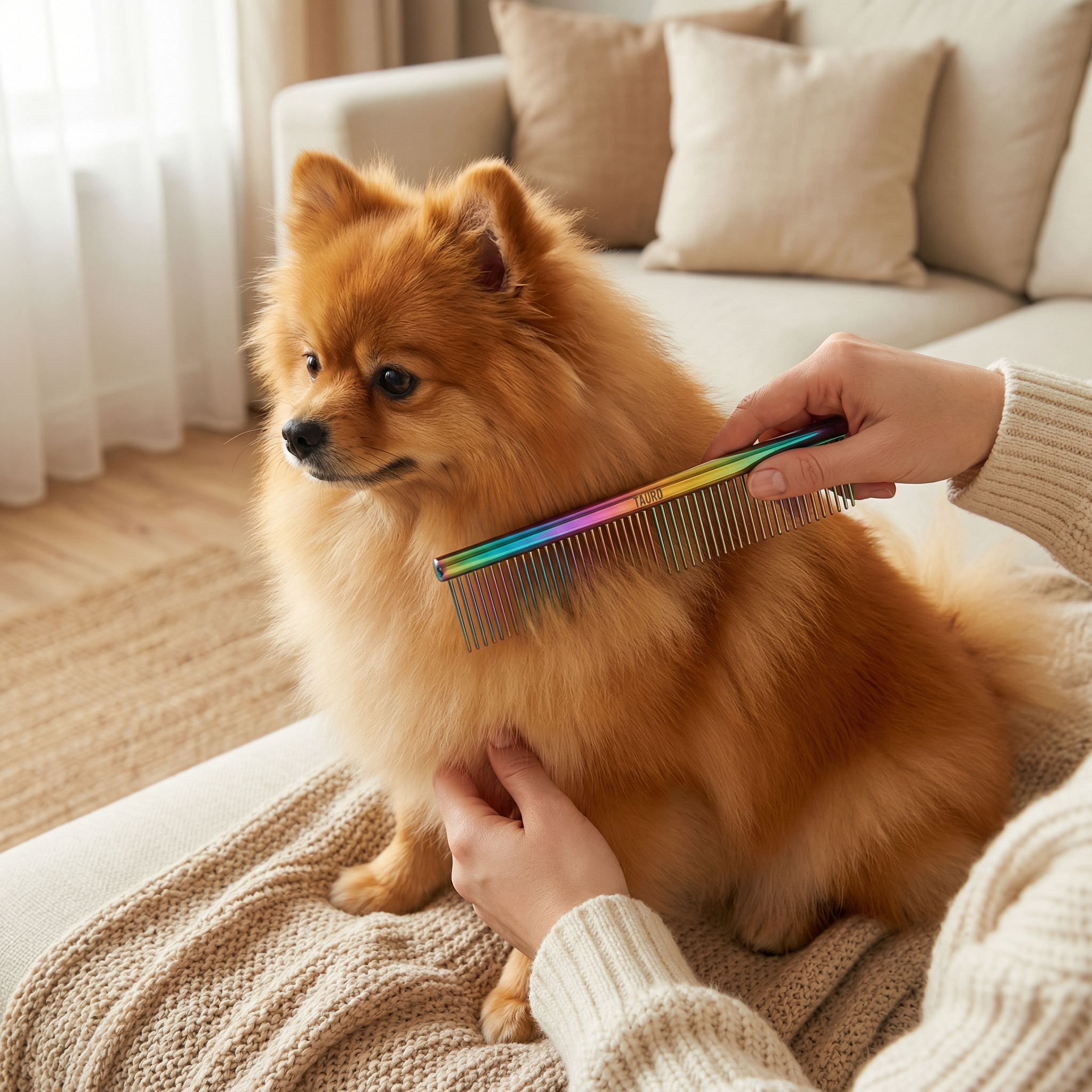
3. Metal combs
This is a control tool.
Used to:
- check if the coat is truly brushed out
- work on sensitive areas (behind ears, armpits)
A quality comb:
- has perfectly smooth teeth
- has no sharp joints
- has appropriate spacing for the coat type
Too narrow spacing for a dense coat – tearing.
Too wide teeth for a silky coat – ineffective.
4. Undercoat removal tools
This is one of the riskiest categories.
When used incorrectly:
- they damage the protective layer
- thin not only the undercoat but also the top coat
- create a “holey” structure
For double-coated breeds:
- undercoat is removed seasonally
- it must not be aggressively “stripped” all year round
Too frequent undercoat removal can disrupt the natural thermoregulation mechanism.
Most common mistakes
❌ Brushing on dry, unprepared coat
Dry hair breaks more easily. It is always recommended to use:
- a moisturizing spray
- a light conditioning mist
❌ Pulling with force
If the brush “gets stuck” – this is not a signal to press harder.
It is a signal to change technique.
❌ One tool for the whole body
Different body zones have different coat density and sensitivity.
❌ Cheap, low-quality tools
Cheap metal joints have micro-edges that:
- damage the cuticle
- cause micro-cracks
- gradually ruin hair structure
A quality tool – how should it “work”?
A quality tool:
✔ glides through the coat, not catches
✔ does not require force
✔ does not cause discomfort to the dog
✔ does not create static charge
✔ does not damage hair structure
It works with the coat, not against it.
How to recognize that tools have already damaged the coat?
Signs:
- the coat becomes fluffy but not dense
- shine disappears quickly
- hair looks “frayed”
- many short broken hairs appear
- the coat starts matting even with regular brushing
In such a case it is necessary to:
- change tools
- reduce mechanical load
- introduce restorative care
An investment that pays off
Very often people invest in expensive cosmetics but save on tools.
In reality:
👉 a good brush lasts for years
👉 it protects against breakage
👉 reduces matting
👉 saves time
👉 reduces stress for the animal
And most importantly – it allows preservation of the coat’s natural potential.
Essential rule
It is better to invest once in:
- the correct brush
- appropriate combs
- a professional undercoat tool
than later:
- try to restore a breaking coat
- fight constant matting
- be disappointed with a “non-growing” coat


 Afghanistan
 Åland Islands
 Albania
 Algeria
 American Samoa
 Andorra
 Angola
 Anguilla
 Antigua and Barbuda
 Argentina
 Armenia
 Aruba
Aruba Australia
 Austria
 Azerbaijan
 Bahamas
 Bahrain
 Bangladesh
 Barbados
 Belarus
 Belgium
 Belize
 Benin
Benin Bermuda
 Bhutan
 Bolivia
 Bosnia and Herzegovina
 Botswana
 Brazil
 Brunei Darussalam
 Bulgaria
 Burkina Faso
 Burundi
 Cabo Verde
 Cambodia
 Cameroon
 Canada
 Cayman Islands
 Central African Republic
 Chad
Chad Chile
Chile China
China Colombia
 Comoros
 Democratic Republic of the Congo
 Congo
Congo Cook Islands
 Costa Rica
 Côte d'Ivoire
 Croatia
 Cuba
Cuba Curaçao
 Cyprus
 Czechia
 Denmark
 Djibouti
 Dominica
 Ecuador
 Egypt
Egypt El Salvador
 Equatorial Guinea
 Eritrea
 Estonia
 Eswatini
 Ethiopia
 Falkland Islands
 Fiji
Fiji Finland
 France
 French Polynesia
 Gabon
Gabon Gambia
 Georgia
 Germany
 Ghana
Ghana Gibraltar
 Greece
 Grenada
 Guatemala
 Guernsey
 Guinea
 Guinea-Bissau
 Guyana
 Haiti
Haiti Honduras
 Hong Kong
 Hungary
 Iceland
 India
India Indonesia
 Iran
Iran Iraq
Iraq Ireland
 Isle of Man
 Israel
 Italy
Italy Jamaica
 Japan
Japan Jersey
 Jordan
 Kazakhstan
 Kenya
Kenya North Korea
 South Korea
 Kuwait
 Kyrgyzstan
 Lao People's
 Latvia
 Lebanon
 Lesotho
 Liberia
 Libya
Libya Liechtenstein
 Lithuania
 Luxembourg
 Macao
Macao North Macedonia
 Madagascar
 Malawi
 Malaysia
 Maldives
 Mali
Mali Malta
Malta Mauritania
 Mauritius
 Mexico
 Micronesia
 Moldova
 Monaco
 Mongolia
 Montenegro
 Montserrat
 Morocco
 Mozambique
 Myanmar
 Namibia
 Nepal
Nepal Netherlands
 New Zealand
 Nicaragua
 Niger
Niger Nigeria
 Norway
 Oman
Oman Pakistan
 Palau
Palau Panama
 Papua New Guinea
 Paraguay
 Peru
Peru Philippines
 Poland
 Portugal
 Puerto Rico
 Romania
 Russian Federation
 Rwanda
 Saint Helena
 Saint Kitts and Nevis
 Saint Lucia
 Saint Vincent and the Grenadines
 Samoa
Samoa San Marino
 Sao Tome and Principe
 Saudi Arabia
 Senegal
 Serbia
 Seychelles
 Sierra Leone
 Singapore
 Slovakia
 Slovenia
 Solomon Islands
 Somalia
 South Africa
 Spain
Spain Sri Lanka
 Sudan
Sudan Suriname
 Sweden
 Switzerland
 Syrian Arab Republic
 Taiwan
 Tajikistan
 Tanzania
 Thailand
 Timor-Leste
 Togo
Togo Tonga
Tonga Trinidad and Tobago
 Tunisia
 Türkiye
 Turkmenistan
 Turks and Caicos Islands
 Uganda
 Ukraine
 United Arab Emirates
 Great Britain
 Uruguay
 Uzbekistan
 Vanuatu
 Venezuela
 Viet Nam
 Virgin Islands
 Yemen
Yemen Zambia
 Zimbabwe