
 Cosmetics
 Grooming equipment
 Grooming tools
 Health and wellbeing
 Accessories


 2026-02-26
Bathing and Drying
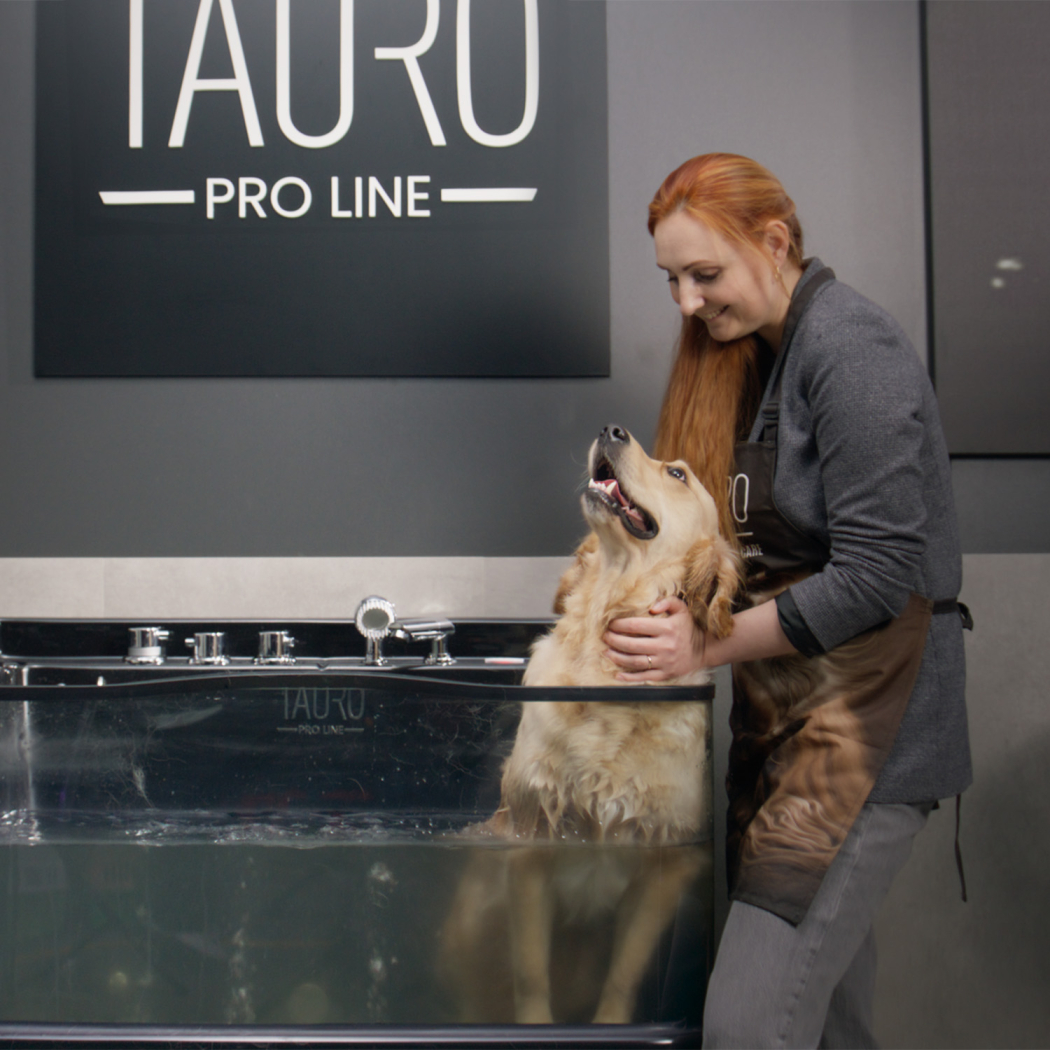
Bathing is not washing, but a care ritual
Regardless of what type of coat an animal has, its care always starts with routine. Routine determines not only coat beauty, but also skin health, follicle strength, and the balance of the whole organism.
Bathing is one of the most important elements of this routine. But it is very important to understand: bathing is not only washing off dirt. It is a procedure that:
- opens the skin,
- allows it to breathe,
- regulates sebaceous gland activity,
- strengthens follicles,
- stabilizes microflora,
- prepares the coat for further protection.
- It is a ritual that affects both aesthetics and biology.

Bathing frequency is not fashion, but logic
For show dogs, bathing is performed regularly – most often once per week. Why? Because their coat must constantly remain stable, elastic, and structurally prepared.
For pet dogs, bathing every four to six weeks is sufficient, taking into account:
- coat type,
- lifestyle,
- environment,
- actual dirtiness,
- skin condition.
It is not the principle that differs, but the frequency of the procedure. The logic remains the same for all animals.
Bathing too rarely allows accumulation of:
- excess oil,
- dust,
- dead skin cells,
- bacteria.
Bathing too often – if incorrect products are used – can damage the skin barrier.
Therefore, the most important thing is not how often, but how correctly.
Stability in the bath is the foundation of safety
During bathing it is very important to ensure the dog’s physical safety.
A rubber or silicone mat must always be used in the bath.
This is not a small detail.
Without a stable base:
- the dog slips,
- tenses up,
- compresses joints,
- tenses muscles.
Tension causes stress.
Stress causes cortisol release.
Cortisol affects skin sensitivity.
When the dog stands stably – it relaxes.
A relaxed dog accepts the procedure better, and the skin remains calmer.
Care starts with safety.
Water temperature is not a small detail
The water must be warm, but not hot.
Water that is too hot:
- dries out the skin,
- opens pores too strongly,
- encourages sebaceous gland hyperactivity.
Water that is too cold:
- causes discomfort,
- forces the dog to tense up,
- reduces absorption of active ingredients.
Optimal – water close to body temperature.
Cosmetics preparation is half of the result
Concentrated cosmetics are never used directly.
They must be properly diluted.
The recommended ratio is 1:10, unless otherwise specified.
Why is this important?
- Correct concentration allows active ingredients to work optimally.
- Too strong a concentration can irritate the skin.
- Too weak will not give an effect.
Cosmetics must be prepared in advance:
- in warm water,
- in special dilution bottles,
- with clearly marked proportions.
Before starting to bathe the dog, all stages must be prepared.
This allows you to work without rushing.
Rushing always reduces the result.
The time factor: biology does not rush
Each cosmetics step must be left to act for no less than 5 minutes.
During this time:
- active ingredients penetrate into the skin,
- pH stabilizes,
- pores open,
- nourishing components begin to work.
If the product is rinsed out after one minute, it does not have time to do its job.
It becomes only "foam rinsing."
Bathing process: structured and consistent
A proper bathing scheme:
1️⃣ Thorough wetting down to the skin
2️⃣ First cleansing shampoo – for surface dirt
3️⃣ Second functional shampoo – according to coat type
4️⃣ Leave for 5 minutes
5️⃣ Thorough rinse
6️⃣ Conditioning / mask
7️⃣ Leave again
8️⃣ Complete rinse
Poorly rinsed cosmetics can become the cause of:
- itching,
- dandruff,
- irritation,
- odor.
Massage is more than touch
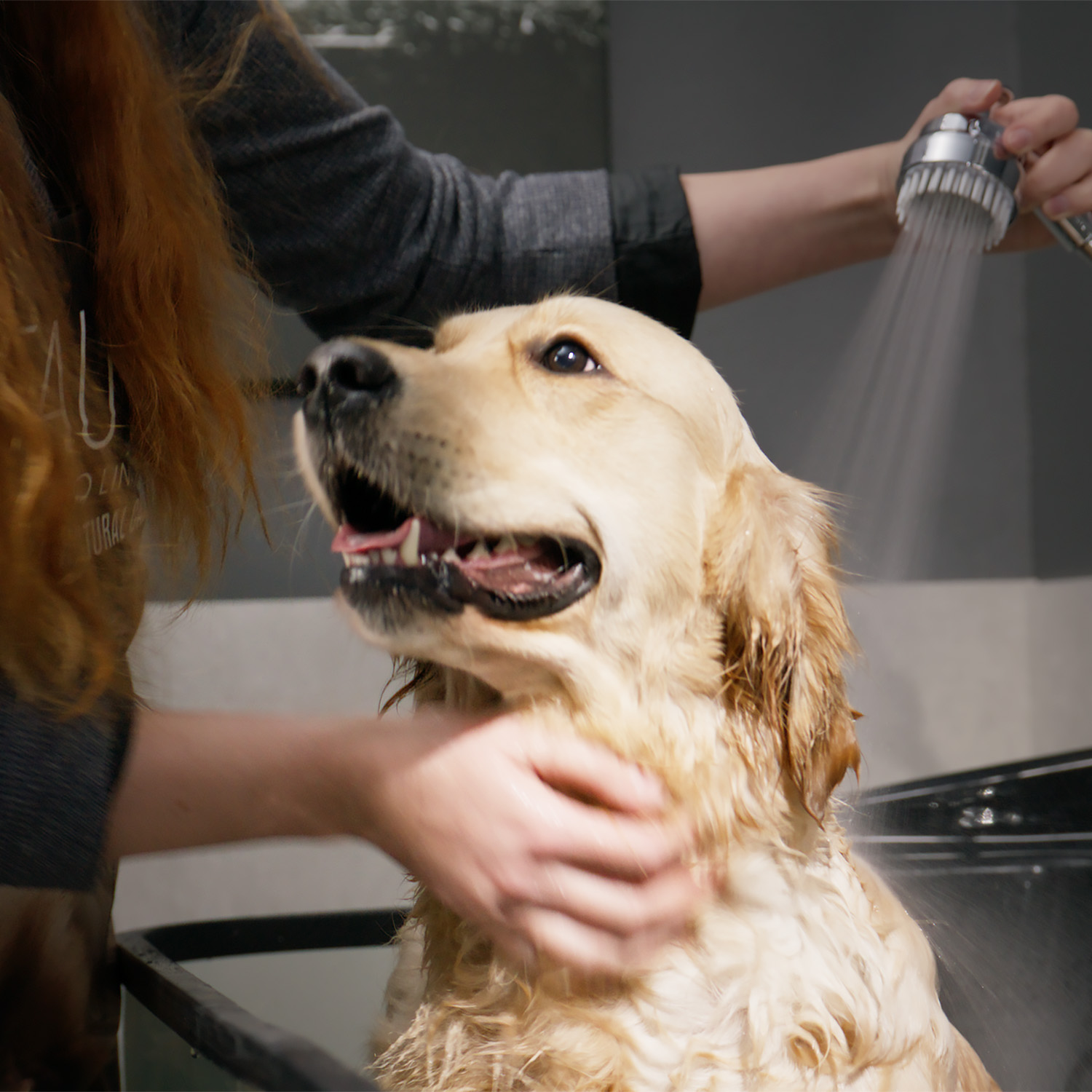
When bathing a dog, you do not need to "scrub." You need to massage.
Gentle massage:
- improves circulation,
- activates follicles,
- helps active ingredients distribute evenly,
- reduces tension.
Movement should be:
- slow,
- directional,
- without nail pressure.
Bathing and the microbiome
Skin microflora is natural protection against bacterial and fungal infections.
Incorrect products or too frequent washing with aggressive cosmetics can destroy it.
Properly selected products:
- maintain natural pH,
- do not destroy good bacteria,
- strengthen the barrier function.
This is especially important for sensitive, allergic, or dermatitis-prone dogs.
Bathing is an emotional aspect
A dog senses a person’s state very well.
If a person:
- rushes,
- gets nervous,
- is tense,
the dog takes it on.
Therefore bathing must be:
- calm,
- clearly structured,
- without sudden movements.
Ritual creates a sense of safety.
When does bathing become a problem?
If after bathing you notice:
- stronger itching,
- redness,
- flaking,
- increased shedding,
the problem may be:
- incorrect concentration,
- incorrect product,
- products not rinsed out,
- too high water temperature,
- bathing too often.
Bathing should not worsen the condition.
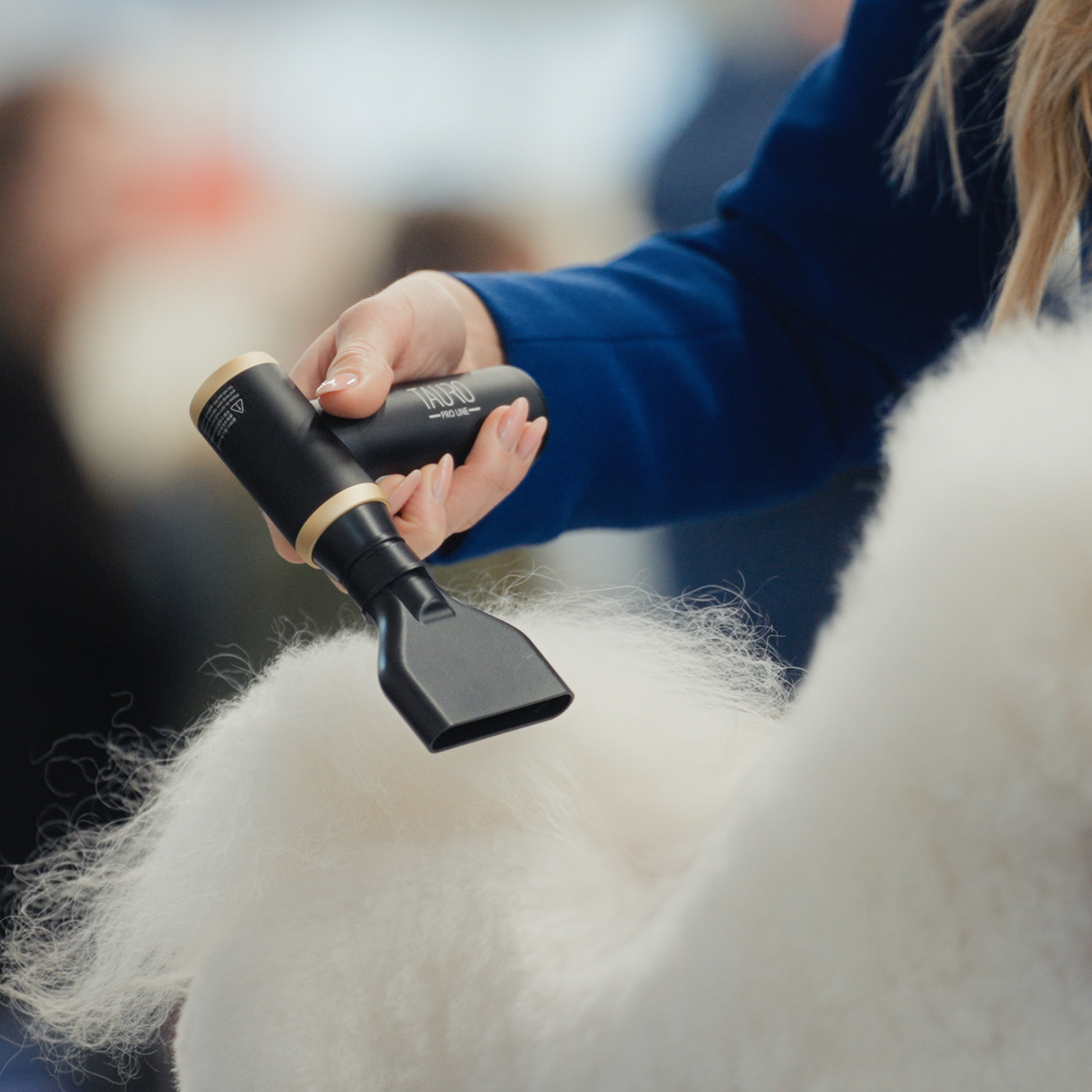
Coat drying: protection, not "baking"
Many people perceive drying as the last, technical step after bathing.
In reality, it is one of the most important stages that determines:
- hair structure,
- skin condition,
- matting risk,
- shedding control,
- the final aesthetic result.
Drying is not "blowing out."
It is structure formation and protection.
Why is drying so important?
Wet hair is:
- more elastic but weaker,
- more vulnerable,
- in an open cuticle state,
- prone to stretching and breaking.
If drying is done incorrectly:
- hair dries out,
- loses moisture balance,
- begins to puff up,
- becomes brittle,
- static charge appears.
If done correctly:
- the hair cuticle is closed,
- moisture is retained,
- matting decreases,
- the skin remains calm.
Main drying goals
✔ Quickly remove moisture
✔ Do not damage hair structure
✔ Do not overheat the skin
✔ Reduce mechanical stress
✔ Stabilize the surface
Drying technologies
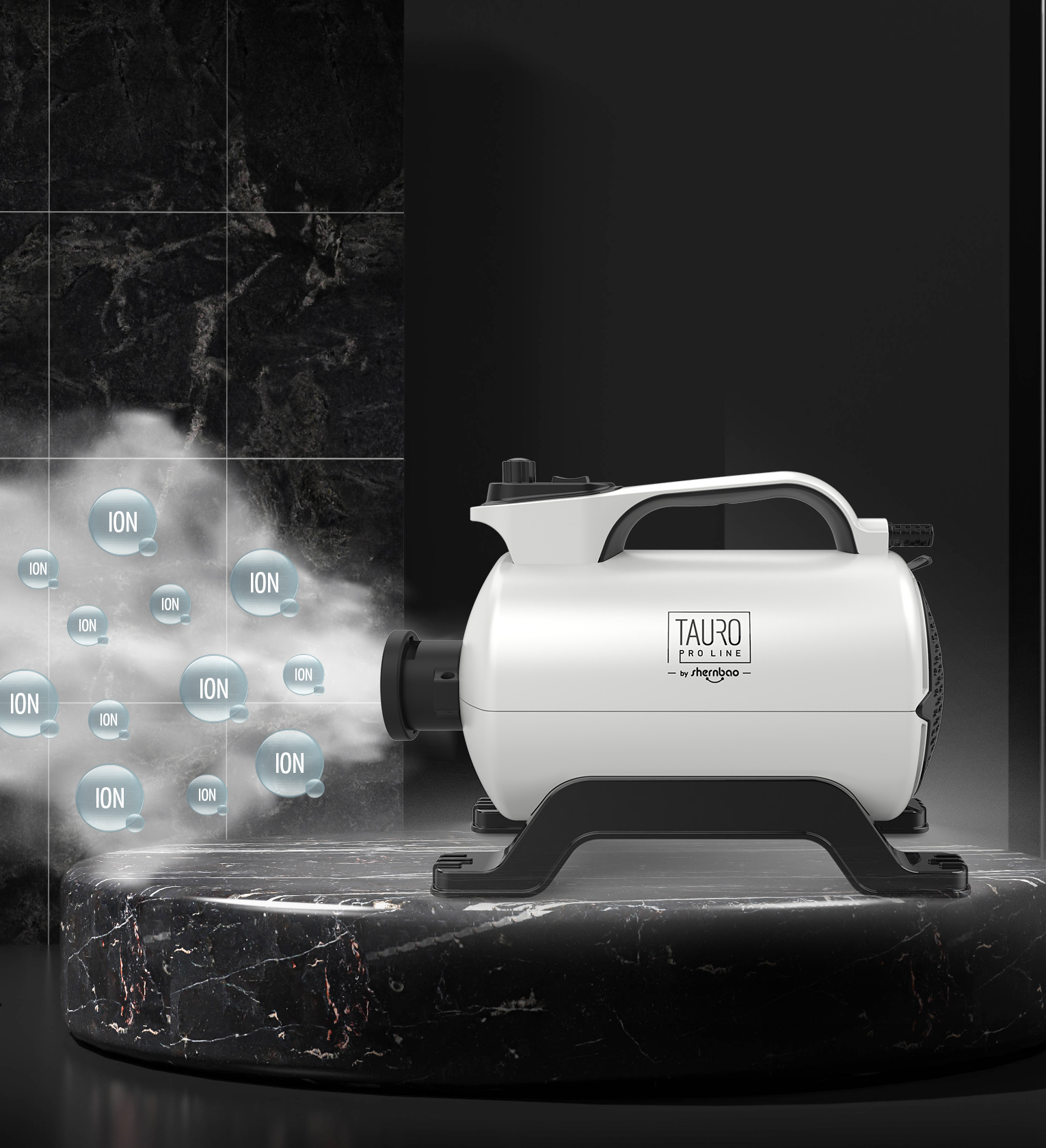
🔹 1. Ionic dryers – the modern standard
Ion technology is not marketing. It is real protection.
How do ions work?
- Neutralize static charge
- Reduce hair puffiness
- Help retain moisture inside the hair
- Close the cuticle
Result:
✔ smoother surface
✔ less breakage
✔ healthier fall
Our goal is not to "blow out" the coat.
The goal is to dry it without damage.
🔹 2. Drying cabinets
This is a particularly valuable solution for:
- salons
- owners with many dogs
- sensitive or stressed animals
How does it work?
The dog is placed in a dryer with adjustable temperature and air circulation.
Within 15–20 minutes:
- most moisture is removed
- there is no mechanical rubbing
- hand workload is reduced
Advantages:
✔ less stress
✔ less noise
✔ more even drying
✔ time saving
It becomes a true "new era" in care.
🔹 3. Compressors (high velocity dryer)
Used for:
- blowing water out of the undercoat
- during shedding
- double-coated breeds
With ion function – even better.
A compressor:
- lifts dead undercoat
- speeds up drying
- reduces the need for aggressive brushing
But very important:
❗ do not hold too close to the skin
❗ do not use maximum temperature
❗ avoid sensitive areas (eyes, ears, groin)
Correct drying sequence
1️⃣ Removing water with a towel
- Do not rub
- Do not press aggressively
- Gently blot dry
Rubbing damages the hair surface.
2️⃣ Primary drying (compressor or cabinet)
Goal – remove 70–80% of moisture.
3️⃣ Forming drying with an ionic dryer
- Medium temperature
- Constant air movement
- Do not hold in one place
- Work along the direction of hair growth
Drying by coat type
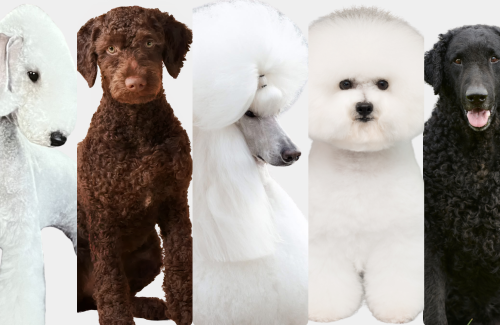
🐩 Curly coat
- Requires structural stretching
- Dried with a brush
- Volume forms only when fully dried
🐕 Double coat
- First the compressor
- Only then the brush
- Moisture must not be left in the undercoat
🐕🦺 Long coat
- Dried in layers
- With slip (leave-in conditioner)
- Temperature – medium
🐶 Short coat
- Most important: do not overheat
- Use more air than heat
Most common drying mistakes
❌ Too high temperature
❌ Drying in one spot
❌ Leaving moisture in the undercoat
❌ Drying without a protective product
❌ Too strong mechanical stretching
This causes:
- breakage
- puffiness
- skin dryness
- inflammation
Ergonomics and groomer health
Drying is one of the most physically demanding stages.
An unsuitable dryer can cause:
- neck pain
- shoulder tension
- wrist overload
Recommended solutions:
✔ Dryers with holders
✔ Stand-mounted models
✔ Neck-hung dryers
✔ Light, balanced construction
This is not luxury.
It is an investment in longevity in the profession.
Training principles: how to teach correct drying?
In professional trainings I emphasize:
🔹 1. Airflow direction control
Not heat, but airflow dries.
🔹 2. Temperature awareness
The feel of the hand is more important than numbers.
🔹 3. Reading the coat
When has the hair already closed?
When is the surface stable?
🔹 4. Working without rushing
Speed ≠ aggression.
Speed = an effective system.
Benefits of drying when done correctly
✔ Shedding decreases
✔ Matting decreases
✔ Cleanliness lasts longer
✔ Structure improves
✔ The skin remains calm
✔ The coat becomes light, alive


 Afghanistan
 Åland Islands
 Albania
 Algeria
 American Samoa
 Andorra
 Angola
 Anguilla
 Antigua and Barbuda
 Argentina
 Armenia
 Aruba
Aruba Australia
 Austria
 Azerbaijan
 Bahamas
 Bahrain
 Bangladesh
 Barbados
 Belarus
 Belgium
 Belize
 Benin
Benin Bermuda
 Bhutan
 Bolivia
 Bosnia and Herzegovina
 Botswana
 Brazil
 Brunei Darussalam
 Bulgaria
 Burkina Faso
 Burundi
 Cabo Verde
 Cambodia
 Cameroon
 Canada
 Cayman Islands
 Central African Republic
 Chad
Chad Chile
Chile China
China Colombia
 Comoros
 Democratic Republic of the Congo
 Congo
Congo Cook Islands
 Costa Rica
 Côte d'Ivoire
 Croatia
 Cuba
Cuba Curaçao
 Cyprus
 Czechia
 Denmark
 Djibouti
 Dominica
 Ecuador
 Egypt
Egypt El Salvador
 Equatorial Guinea
 Eritrea
 Estonia
 Eswatini
 Ethiopia
 Falkland Islands
 Fiji
Fiji Finland
 France
 French Polynesia
 Gabon
Gabon Gambia
 Georgia
 Germany
 Ghana
Ghana Gibraltar
 Greece
 Grenada
 Guatemala
 Guernsey
 Guinea
 Guinea-Bissau
 Guyana
 Haiti
Haiti Honduras
 Hong Kong
 Hungary
 Iceland
 India
India Indonesia
 Iran
Iran Iraq
Iraq Ireland
 Isle of Man
 Israel
 Italy
Italy Jamaica
 Japan
Japan Jersey
 Jordan
 Kazakhstan
 Kenya
Kenya North Korea
 South Korea
 Kuwait
 Kyrgyzstan
 Lao People's
 Latvia
 Lebanon
 Lesotho
 Liberia
 Libya
Libya Liechtenstein
 Lithuania
 Luxembourg
 Macao
Macao North Macedonia
 Madagascar
 Malawi
 Malaysia
 Maldives
 Mali
Mali Malta
Malta Mauritania
 Mauritius
 Mexico
 Micronesia
 Moldova
 Monaco
 Mongolia
 Montenegro
 Montserrat
 Morocco
 Mozambique
 Myanmar
 Namibia
 Nepal
Nepal Netherlands
 New Zealand
 Nicaragua
 Niger
Niger Nigeria
 Norway
 Oman
Oman Pakistan
 Palau
Palau Panama
 Papua New Guinea
 Paraguay
 Peru
Peru Philippines
 Poland
 Portugal
 Puerto Rico
 Romania
 Russian Federation
 Rwanda
 Saint Helena
 Saint Kitts and Nevis
 Saint Lucia
 Saint Vincent and the Grenadines
 Samoa
Samoa San Marino
 Sao Tome and Principe
 Saudi Arabia
 Senegal
 Serbia
 Seychelles
 Sierra Leone
 Singapore
 Slovakia
 Slovenia
 Solomon Islands
 Somalia
 South Africa
 Spain
Spain Sri Lanka
 Sudan
Sudan Suriname
 Sweden
 Switzerland
 Syrian Arab Republic
 Taiwan
 Tajikistan
 Tanzania
 Thailand
 Timor-Leste
 Togo
Togo Tonga
Tonga Trinidad and Tobago
 Tunisia
 Türkiye
 Turkmenistan
 Turks and Caicos Islands
 Uganda
 Ukraine
 United Arab Emirates
 Great Britain
 Uruguay
 Uzbekistan
 Vanuatu
 Venezuela
 Viet Nam
 Virgin Islands
 Yemen
Yemen Zambia
 Zimbabwe